


Most family law firms have a website, but it doesn’t generate new clients. People search for a family lawyer, your firm doesn’t show up, and a competitor gets the call instead.
This is a bigger problem than it sounds like. Someone searching for a divorce or custody lawyer isn’t casually browsing; they’re often scared, stressed, and ready to hire fast. If you’re not visible right then, you don’t just lose a click. You lose a client who needed help and a case you could have taken. And every month the issue goes unfixed; your competitors who do show up on Google keep pulling ahead.
That’s precisely what SEO for family law firms fixes. It’s the process of making sure your firm shows up first when people search for the exact help you offer through better local visibility, a faster website, trustworthy content, and stronger rankings. This guide walks through exactly how to do that, step by step.
Consider this:
87% of people still turn to Google to help decide which law firm to hire, and nearly 98% (Clio’s Legal Trends Report) want to talk to at least two firms before choosing one. Whichever firm shows up first and looks most trustworthy when they do has a real head start before the phone ever rings.
SEO for Family Law: Quick Takeaways
Family law SEO has many components, but only a few factors drive most of the results. If you only have five minutes, here are the key points to focus on before you read the details below:
- Local SEO pays off fastest: start there
- Slow or clunky mobile site? Fix that first. Nothing else matters until it’s optimised.
- Reviews and real attorney bios build trust: with Google and with clients
- Keep content accurate and current: Google holds legal content to a higher bar
- AI search is now part of the game: people are getting answers from AI Overviews and ChatGPT before they even visit a site
- Be patient, not passive: expect real results in 3 to 6 months, growing from there
What is SEO for Family Law?
At its core, SEO for family law is about making sure that when someone searches for divorce, custody, or adoption help, your firm is the one they find, click on, and trust enough to call. As part of a comprehensive SEO services strategy, it combines keyword research, on-page optimization, technical SEO, local listings, content creation, and backlink building all aimed at one outcome: more consultations booked, not just more visitors.
It’s the same fundamental discipline as SEO in any industry, but it’s applied to a niche where locality, accuracy, and trust matter more than almost anywhere else online.
Why Family Law SEO Is Different from Traditional SEO
Family law sits in what Google calls the “Your Money or Your Life” (YMYL) category of content that can genuinely affect someone’s finances, custody, or safety. So Google is pickier here than it would be with a page about the best hiking trails nearby:
- Reviews, credentials, and genuine authorship carry more weight.
- Competition includes not just other firms but large legal directories like Avvo and FindLaw.
- Searchers aren’t casually browsing; they’re often mid-crisis and deciding fast.
How Potential Clients Search for Family Lawyers
Not everyone searches the same way. Some people are ready to call right now; others are just trying to understand what’s happening to them. Here’s what that usually looks like:
- Ready to hire: searches like “divorce attorney [city]” or “family lawyer near me”
- Trying to understand their situation: searches like “how does child custody work” or “how much does divorce cost”
- Comparing lawyers before deciding: searches like “best family lawyer in” or “[firm name] reviews”
- Need help fast: searches like “emergency custody lawyer” or “file for divorce today”
Why SEO Matters for Family Law Firms
SEO isn’t a marketing checkbox for a family law firm; it’s often the difference between a full calendar and an empty one because of how family law clients actually behave online. Below are the specific reasons it matters so much for this practice area.
Build Trust Before the First Consultation
By the time a prospective client calls, they’ve already:
- Read your site
- Skimmed a few reviews
- Checked your attorney bios
Most of the trust-building happens before you say hello, which means your website is doing a job your intake team never gets to. Weak SEO doesn’t just mean fewer visitors; it means the people who do land on your site arrive with less context and less confidence, which shows up later as lower consultation-to-client conversion.
Increase Local Visibility
Family law is a local business at heart. Court procedures, filing requirements, and custody norms all shift by jurisdiction, and most people want an attorney they can sit across from. Showing up in the local map pack right when someone nearby is searching puts you in front of people who can actually become clients, not just curious readers from another state.
The numbers make the case on their own:
- Backlinko’s analysis of local search results found that about 42% of users click on results from the Google 3-pack when performing a local search.
- Industry data compiled from sources like Backlinko shows that businesses appearing in the map pack receive roughly 126% more traffic and about 93% more calls, clicks, and direction requests than listings ranked 4-10.
Stay Competitive Against Bigger Firms and Directories
Here’s the part a lot of smaller firms underestimate: you’re not just competing with the firm down the street. You’re competing with well-funded regional practices and large legal directories that already dominate page one. Without a deliberate SEO strategy, a smaller or newer firm gets buried under listings that aren’t even a real law office, just directory profiles.
Achieve Long-Term ROI
Paid ads stop working the moment you stop paying for them. SEO isn’t like that. A well-built page can keep generating consultations two or three years later with just some upkeep, which makes it one of the more cost-efficient channels a firm can invest in over time, especially compared to the rising cost-per-click on family law keywords in Google Ads.
According to SEO ROI research compiled by Shno.co, legal services firms see approximately 526% SEO ROI on average over a three-year period, a very different trajectory than a paid campaign that goes quiet the day the budget does.
Did You Know?
Family law is consistently one of the most expensive legal niches for Google Ads clicks, often $20–$100+ per click in competitive markets. SEO traffic, once earned, costs nothing per click. That’s the long game worth playing.
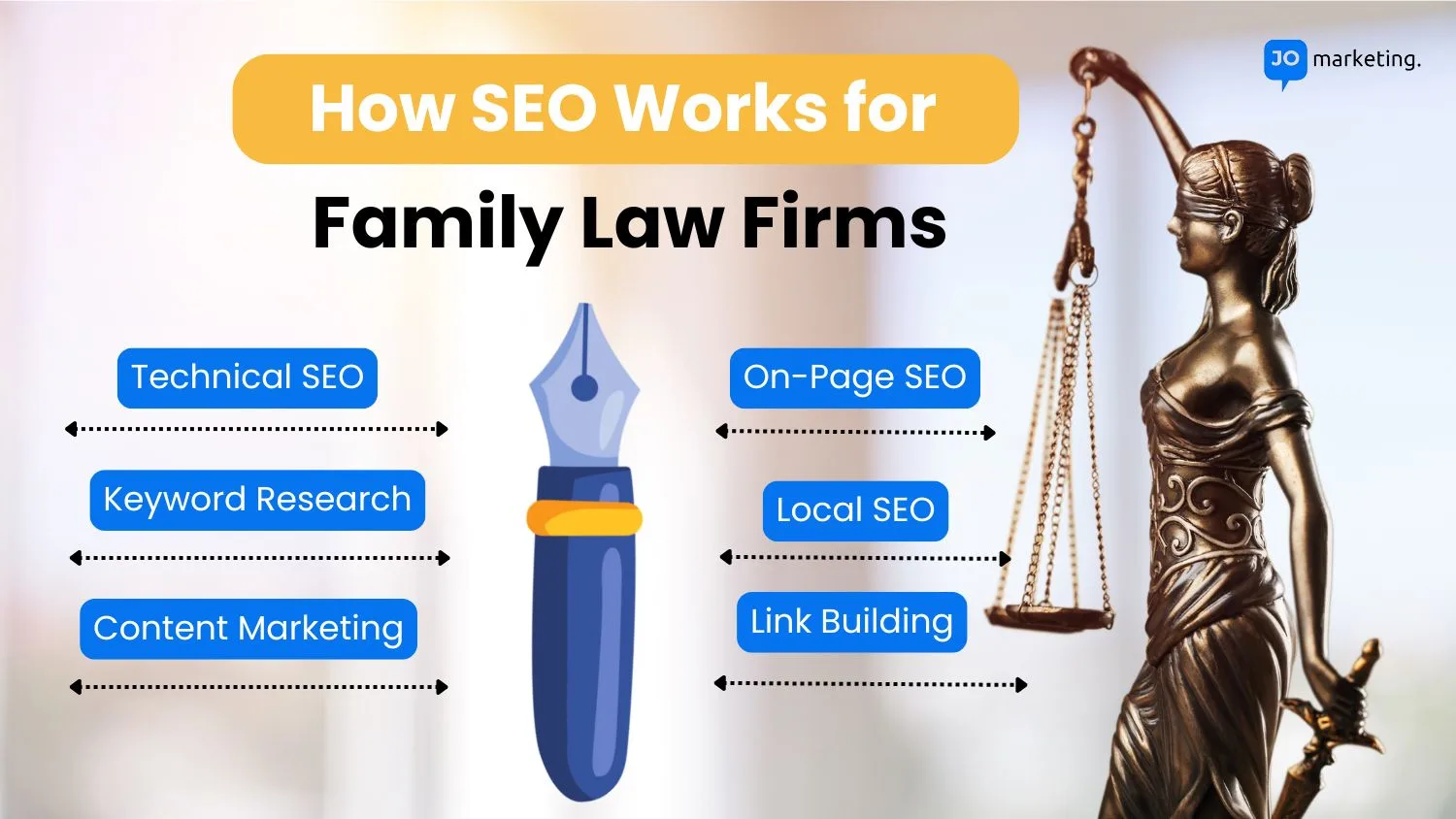
How SEO Works for Family Law Firms
Family law SEO isn’t one single tactic; it’s several moving parts working together. Skip one (say, technical SEO) and the rest tend to underperform no matter how good your content is. Here’s how they fit together.
Keyword Research
This starts with understanding how people actually phrase things, not just “family lawyer,” but the specific situations they’re dealing with: custody modifications, prenups, adoption, and protection orders. A solid mix usually blends the following:
- Core service terms like “seo for family law firms” or “family law attorney”
- Long-tail phrases that reveal real intent, like “how to file for divorce” or “seo for law firm websites”
- Local modifiers, tying a service to a specific city or neighborhood
Tools like Ahrefs, Semrush, and Google Keyword Planner are the standard starting points for this kind of research. Google Keyword Planner pulls volume data straight from Google’s own search data, while Ahrefs and Semrush add competitive and intent-level detail on top.
On-Page SEO
On-page SEO refers to everything visible on the page itself: title tags, meta descriptions, headers, internal links, and keywords woven into content that’s genuinely useful, not stuffed in to please a search engine.
For a family law site, this means:
- Meta Title: Write for users first, then search engines. Keep it 50–60 characters (up to ~600 pixels) and clearly communicate the page’s value.
- Meta Description: Summarize what users will gain from the page. Keep it 150–160 characters and include a compelling reason to click.
- Header structure (H1, H2, H3) that mirrors how a worried client actually thinks through a problem, e.g., a custody modification page moving from “What Counts as a Substantial Change?” to “How the Process Works” to “What It Costs.”
- Internal linking that connects related situations, a divorce page linking to child support, asset division, and mediation pages so both users and Google understand how the practice areas relate.
- Keyword placement that reads naturally. A page can rank for “prenup lawyer near me” without ever repeating that exact phrase five times; search engines today reward topical depth and genuine usefulness over keyword density.
Technical SEO
The invisible plumbing: site speed, mobile responsiveness, HTTPS, clean URLs, and schema markup. If this is broken, Google can’t properly crawl or trust the site, and everything else becomes wasted effort.
The parts worth calling out specifically:
- Site speed matters more than most firms realize; a slow-loading page loses visitors before they even see the content, and Google factors load time into rankings directly.
- Mobile responsiveness isn’t optional; a large share of people searching “divorce lawyer” or “emergency protective order” are doing it from a phone, often in a moment of urgency.
- HTTPS and clean URLs signal basic trustworthiness both to Google and to a client already anxious about sharing sensitive information online.
- Schema markup (structured data) helps Google understand what a page is about marking up attorney bios, FAQs, and reviews so they can surface as rich results, like star ratings or FAQ dropdowns, directly in search.
- Crawlability and indexing making sure Google can actually find and read every page, with no broken links, duplicate content, or blocked pages quietly torpedoing the rest of the strategy.
Local SEO
For a business this location-dependent, local SEO tends to be the fastest lever to pull: your Google Business Profile, consistent listings, and location pages that actually say something useful.
Key components:
- Google Business Profile optimization: Accurate categories, hours, attorney photos, and regular posts/updates, since this is what populates the map pack.
- NAP consistency: (Name, address, and phone) across every directory and citation site; conflicting information across the web actively hurts local rankings.
- Location-specific landing pages: For firms serving multiple cities or counties each one addressing local court procedures or filing requirements, not just a copy-pasted page with the city name swapped out.
- Review generation and management: Actively requesting reviews from past clients and responding to them, since review volume and recency are ranking factors in the local pack.
Link Building
Backlinks from legal directories, bar associations, and local press signal legitimacy. For law firms, a handful of relevant, high-quality links beats a pile of random ones.
Where those links tend to come from:
- Legal directories like Avvo, Justia, and FindLaw, which carry industry-specific authority.
- Bar association and professional organization listings, which double as a trust signal for both Google and prospective clients.
- Local press and community involvement: being quoted in a local news story about a change in custody law or sponsoring a community event earns links that are hard for competitors to replicate.
- Guest contributions and expert commentary on legal or parenting publications, positioning the attorney as a source rather than just a service.
The quality bar matters here more than almost anywhere else in SEO a single link from a state bar association carries more weight than dozens from low-quality, unrelated directories, and Google has gotten increasingly good at penalizing manipulative link schemes.
Content Marketing
Rarely does a well-written “About Us” page foster the same level of confidence as blog posts and FAQ sites that really address the queries visitors are currently posing. When someone searches for “how long does an adoption take in Ohio,” they don’t want a polished bio; instead, they want a direct response, and the company that provides it gains more credibility than one that remains ambiguous.
For this reason, FAQ pages typically perform better than standard service pages, and blog posts that discuss the practical and emotional aspects of a situation rather than just the legal details gain the trust of a worried, late-night searcher. Another layer is added by downloadable materials like custody checklists, which transform content into a tool for generating leads. Furthermore, none of this is effective as a one-time push: a website with a few outdated pages will always perform worse than one that publishes regularly as laws and issues change.
Local SEO for Family Law Firms
Local SEO is frequently the main source of quality leads for family law companies. Google gives local companies priority in its search results since the majority of individuals looking for a divorce lawyer, child custody lawyer, or family law counsel prefer someone close.
This implies that your objective is to show up in the Google Local Pack (Map Pack), where prospective customers can quickly discover your company, reviews, phone number, and directions, rather than merely ranking on page one. Compared to many traditional SEO efforts, a well-optimized local presence can produce more calls and consultations.
Optimize Your Google Business Profile
This is often the first thing a prospective customer thinks of your business. Update the profile on a regular basis, include real photos of your team and workspace, and maintain your practice locations, hours, and phone number up toworkspace;revent it from looking abandoned.
A complete profile isn’t just tidy it converts. According to Google and Ipsos research, businesses with a fully filled-out business profile are 2.7x more likely to be seen as reputable, 70% more likely to get a visit, and 50% more likely to be considered for a purchase
To increase visibility:
- Fill up the business description, services, practice areas, and qualities sections of your profile.
- Choose the major and supplementary categories (like Family Law Attorney) that are most pertinent.
- Verify the accuracy of your company’s name, address, phone number, website, and office hours.
- To foster trust, provide high-quality images of your staff, office, welcome area, and logo.
- To have your legal services show up in pertinent searches, add each one separately.
- To keep your profile current, publish frequent Google Posts regarding legal updates, FAQs, blog entries, or community activity.
- Turn on texting (if it’s accessible) and answer questions right away.
- Keep an eye on the Q&A area and respond to frequently asked client queries before others do.
- Examine your company profile analytics on a regular basis to learn how people locate and engage with your listing.
You may improve your chances of showing up in Google’s Local Pack and turn searches into customers by maintaining an active, comprehensive, and well-maintained Google Business Profile.
Keep NAP Information Consistent
Your Name, Address, and Phone number (NAP) need to match exactly everywhere: your website, your Google Business Profile, and every directory you’re listed on. It sounds minor, but small inconsistencies like a missing suite number or “St.” instead of “Street” can quietly confuse Google and hold your rankings back without you ever noticing why..
Encourage Client Reviews
Reviews carry real weight, both for rankings and for someone deciding whether to trust you with something this personal. Build a habit of asking happy clients to leave one, and respond to every review, good or bad.
The difference is bigger than most firms expect: businesses with 50+ Google reviews are 266% more likely to appear in the Local Pack than businesses with fewer than 10 reviews, according to BrightLocal’s 2026 research.
Google has also tightened its review policy in April 2026, and it changes how you should be asking for reviews. Here’s what’s now off-limits:
- No review quotas: directing staff to hit review targets is now a violation.
- No naming staff: you can’t ask clients to mention a specific employee in their review.
- No incentives: discounts, gifts, or perks in exchange for a review remain banned.
- No review gating: filtering customers by sentiment before sending the review request is prohibited.
- No on-premises pressure: shared kiosks or in-office prompts are off the table too.
Google isn’t just writing these rules down and hoping people follow them, either. In its 2025 Trust and Safety reporting, Google said it blocked or removed more than 292 million policy-violating reviews in a single year.
For a law firm, the safest move is to keep the ask simple and neutral, something like “We’d really appreciate it if you shared your experience on Google” sent after the case wraps up rather than while the client is still sitting in your office.
A direct review link or QR code works well here since it removes friction without crossing into pressure, and if you want the full rundown straight from the source, Google’s own Maps User-Generated Content Policy lays out exactly what’s allowed.
Create Location-Specific Landing Pages
If you serve more than one city or county, give each one its own page with content that reflects local courts and procedures, not a copy-paste job with the city name swapped out. For example, a firm serving both Franklin County and Delaware County might have separate pages that each reference the actual county courthouse, local filing timelines, and judge-specific procedural quirks rather than one generic “family law services” page with the county name changed twice. That kind of specificity is exactly what signals to Google (and to a nervous prospective client) that the page is genuinely useful, not templated.
You can see this in action with clients who take a localized approach, building out separate location pages for each suburb or area they serve, rather than relying on one generic services page to cover everywhere at once. This kind of specificity often leads to a noticeable increase in local search visibility within just a few months, since each page speaks directly to that neighborhood’s audience. It’s exactly the kind of targeted relevance that search engines and prospective clients respond to.
Did You Know?
Search your firm’s name on Google and review your online listings. If you notice any differences in your business name, address, or phone number, update them to ensure consistent local SEO signals
Building Trust and Authority for Better Legal SEO
As part of its Search Quality Rater Guidelines, Google uses a methodology known as ‘E-E-A-T‘ (Experience, Expertise, Authoritativeness, and Trustworthiness) to assess lawful material.
The most important “Your Money or Your Life” (YMYL refers to content that can significantly affect a person’s health, finances, safety, or legal rights, so Google holds it to a much higher standard of accuracy and trust) subjects are those that have an impact on a person’s health, finances, or legal status, all of which are directly related to family law.
To put it briefly:
- Authoritativeness examines whether the website and author are regarded as reliable in the industry;
- Experience determines whether the content reflects genuine, first-hand familiarity with the subject;
- Expertise determines whether the writer is truly qualified, such as a licensed attorney rather than a general content writer, and accuracy, open authorship, and a safe, trustworthy website are all components of trustworthiness.
In the context of family law in particular, this isn’t simply an algorithmic checkbox; it’s also precisely what a nervous, apprehensive prospective client is unconsciously searching for: evidence that the author has really handled situations similar to theirs and can be trusted with something this intimate
Demonstrate Real Experience
You want to show, not just tell. Case outcomes (where ethically permitted), genuine testimonials, and content actually written or reviewed by an attorney all demonstrate the kind of first-hand experience Google’s guidelines specifically look for and honestly, it’s the same thing a potential client is quietly checking for too.
Showcase Attorney Credentials
A thin, generic bio doesn’t do much for anyone. If you list your bar admissions, years in practice, notable case types, and any awards, you’re giving both Google and a potential client real reasons to decide you’re the one to call.
Publish Accurate and Helpful Legal Content
Since this is YMYL content, you don’t get to cut corners on accuracy. Have an actual attorney review anything that goes live, reference real statutes or procedures where it’s relevant, and skip the kind of generic advice that could apply to any firm, anywhere, because that’s usually the first sign a site was written by someone who’s never set foot in a courtroom.
Build Trust with Reviews and Testimonials
Reviews matter, but don’t stop there; the basics count too. A visible privacy policy and contact information that isn’t buried three clicks deep make a difference. If you’re asking someone to share deeply personal details with you, they notice this stuff, even if only subconsciously.
AI Search Optimization for Family Law Firms
Search isn’t just blue links anymore. A growing number of legal questions now get answered directly inside Google’s AI Overviews or through tools like ChatGPT and Gemini sometimes before anyone clicks a website at all.
How AI Search Is Changing SEO
For family law firms, this means visibility isn’t only about ranking #1 on a traditional results page anymore. It’s about becoming the source these tools trust enough to cite by name.
This isn’t a fringe trend anymore.
Local search results are already contending with AI-generated answers AI Overviews now appear in roughly 68% of local searches, compared to 39% for the traditional local pack, according to Search Engine Journal’s 2026 reporting. And it’s not just search results; changing the way people find attorneys is shifting too: ChatGPT usage for attorney research has grown more than 4.5x in three years, climbing from 9% in 2023 to nearly 42% in 2026, according to iLawyer Marketing’s annual consumer research.
Optimizing for AI Overviews
AI overviews tend to favour content that answers a specific question clearly and comes from a source that looks credible. Clean FAQ sections, sensible headers, and answers that get to the point tend to perform better here.
Generative Engine Optimization (GEO)
GEO applies familiar SEO fundamentals authority, structure, and credibility to how AI tools choose what to summarise. In practice, that means clear question-and-answer content, solid backlinks, and consistent mentions of your firm across the web.
Creating AI-Friendly Legal Content
Lead with the answer, then add context. Use headers that mirror how a real person would phrase the question. It happens to read better for humans and work well for AI summarisation a rare case where both goals align.
Common SEO Mistakes Family Law Firms Should Avoid
Most of the SEO problems we see in family law firms aren’t dramatic; they’re small, quiet issues that add up over time. Here’s what to watch for, and the quick fix for each.
Mistake | Why it hurts | Quick fix |
Ignoring local SEO | Misses the highest-intent, nearby clients | Fully complete your Google Business Profile first |
Keyword stuffing | Hurts readability and can trigger penalties | Write naturally; let keywords fit where they make sense |
Thin, outdated content | Signals low expertise and low trust | Update pages regularly and add real depth |
Duplicate location pages | Dilutes rankings across all versions | Write unique content for each city/service area |
Slow website speed | Increases bounce rate, hurts rankings directly | Run a speed test and fix the biggest offenders first |
Poor mobile experience | Most legal searches happen on mobile | Test your site on an actual phone, not just a desktop preview |
Ignoring AI search | Misses a growing share of client discovery | Structure content in clear Q&A format |
Should You Hire an SEO Service for Family Law?
This usually comes down to time, competition in your market, and how quickly you need results. Here’s a simple way to think about it.
DIY SEO vs Hiring an Agency
DIY | Hiring an Agency | |
Best for | Firms with time and some marketing know-how | Firms wanting faster, more consistent results |
Learning curve | Steep, especially for technical SEO | Handled for you |
Cost | Lower upfront, higher time investment | Ongoing monthly cost, less time from you |
Speed to results | Slower, trial-and-error | Usually faster with established processes |
What to Look for in an SEO Agency
Look for actual experience with legal or other high-trust industries, reporting you can understand without a decoder ring, and results you can verify rather than just take their word for.
For reference, law firms typically allocate 2–10% of total revenue toward marketing and client acquisition, spending between $5,000 and $50,000 a month on digital marketing channels, including web design, SEO, PPC, and social media. Firms serious about growth tend to spend more specifically on SEO. Annual SEO spend for firms doing it well typically runs $120,000 to $150,000, which is useful context when you’re evaluating whether a quote is reasonable. (via Marketing Strategia’s 2026 analysis)
Questions to Ask Before Hiring
- Have you worked with law firms or similar YMYL industries before?
- What does your approach to local SEO and Google Business Profile actually look like?
- How do you handle content and link building?
- How do you report results, and how often?
- What’s a realistic timeline, and are you willing to say so honestly?
Benefits of Professional Family Law SEO Services
A respectable family law-focused SEO company may assist your business in getting superior outcomes more quickly. Beyond technical proficiency, the ideal partner is aware of the particular difficulties associated with legal marketing and is skilled at creating a lasting web presence.
- Faster execution through proven SEO processes and workflows.
- Established relationships with reputable legal directories and industry resources.
- Strong understanding of Google’s E-E-A-T (Experience, Expertise, Authoritativeness, and Trustworthiness) guidelines for legal websites.
- Data-driven strategies focused on increasing qualified leads rather than just rankings.
- A shorter path from SEO planning to generating more phone calls and client inquiries.
Family Law SEO Checklist
Use this as a working list, not a one-time task SEO is maintenance, not a launch-and-forget project.
Website Optimization Checklist
- Clear, descriptive title tags and meta descriptions on every page
- Fast, mobile-friendly design
- HTTPS and a clean, modern feel overall
- Obvious calls-to-action: call, book, contact on every page
Local SEO Checklist
- Fully filled-out Google Business Profile
- Consistent NAP everywhere your firm is listed
- An actual process for getting and responding to reviews
- Location-specific pages for each area you serve
Content Checklist
- Practice-area pages that genuinely answer client questions
- Real attorney bios with real credentials
- FAQs structured for both readers and AI tools
- Content that gets reviewed and updated, not left to rot
Technical SEO Checklist
- Logical site structure and internal linking
- Schema markup where it applies (LegalService, Attorney)
- No duplicate or thin content across location pages
- Regular SEO audits to identify and resolve technical and on-page issues.
Final Thoughts
Good SEO for family law isn’t about chasing rankings for their own sake. It’s about being findable, credible, and easy to trust at the exact moment someone’s going through one of the hardest chapters of their life. Get the local basics right, back it up with content that actually helps, keep the technical side clean, and don’t ignore where AI search is heading and you end up with something far more durable than any single ad campaign: a steady stream of people who found you, trusted you, and picked up the phone.
Ready to actually fix this instead of just reading about it? Get your free Website & SEO Audit
Frequently Asked Questions
Why is SEO important for family law firms?
Because that’s where your clients already are searching, comparing, and deciding before they ever pick up the phone. SEO makes sure your firm shows up in that moment, builds trust before the first call, and keeps bringing in consultations long after a paid ad campaign would have stopped.
Do I need to hire an SEO expert to optimise my website?
Not necessarily; some firms manage the basics themselves, especially local SEO like Google Business Profile and reviews. But family law is competitive, technical SEO has a real learning curve, and most firms see faster, more consistent results working with someone who does this full-time. If you’re short on time or not seeing results on your own, that’s usually the sign to bring in help.
Is local SEO important for family law firms?
Very much so. Since family law is inherently a local service, local SEO, Google Business Profiles, citations, and reviews are usually where firms see the fastest return.
How much does SEO cost for a family law firm?
It varies depending on how competitive your market is and the scope of work, but ongoing monthly retainers commonly range from a few hundred to several thousand dollars.
Can SEO generate more family law clients?
Yes, by putting your firm in front of people actively searching for exactly what you offer, SEO turns into a fairly direct pipeline of new consultations over time.
-
Aasish Thapa
- Text Here